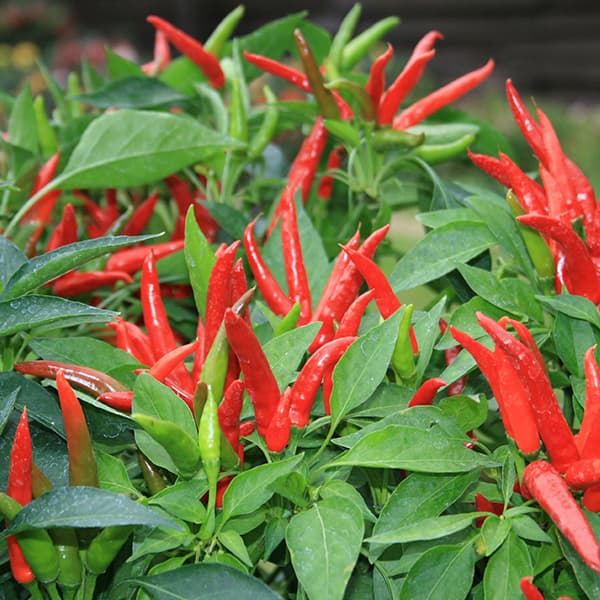
1: An Introduction to Commercial Chilli Cultivation
Chilli, a member of the Solanaceae family alongside potatoes and tomatoes, is cultivated for its fleshy fruits in tropical and subtropical regions.
The crop produces capsaicin, a pungent chemical measured using the Scoville scale, and serves as a rich source of vitamins A, C, and B6, as well as potassium, magnesium, and iron.
Two highly recommended varieties are the "Long Cayenne" and the "African Bird's Eye" (ABE).
The Long Cayenne is a tall, highly productive plant with slim, 10 cm-long fruits featuring very thin and pungent flesh, making it ideal for the fresh market, drying, and export.
The ABE variety grows as a perennial bushy shrub and produces small, extremely hot, conical fruits up to 3 cm long that turn bright red or purple when mature.
For optimal growth, chilli requires an altitude of 0 to 1,200 meters above sea level, annual rainfall between 600 and 1,200 mm, and growing temperatures ranging from 20 to 30 °C. The soil must be well-drained with a pH between 6.0 and 6.5.
2: Establishing a Resilient Chilli Crop: Nursery Management and Transplanting
Successful chilli production begins in a well-managed nursery requiring about 75 g of seed per acre.
The nursery site should be located in a well-drained, friable soil plot near a water source, protected from animals, and completely free from Solanaceae family crops for the past three years. Nursery beds should be 1 meter wide, with soil tilled fine and mixed with 10 to 15 kg of potent manure per square meter. Seeds are sown 1.5 cm deep in holes spaced 15 to 20 cm apart, covered with mulch, and watered thoroughly.
Seedling trays are highly recommended for expensive hybrid seeds because they offer uniform germination. Beds must be watered daily; once germination begins after 1 to 3 weeks, the mulch is removed and replaced with a temporary 50% shade net or grass structure. Seedlings undergo hardening off in the fourth and fifth weeks post-emergence by reducing shade and lowering watering frequency to three times a week.
Transplanting occurs when seedlings reach the 4 to 6 leaf stage at 5 to 6 weeks. Seedlings are planted during the cooler parts of the day at the onset of the rainy season. Depending on the variety, spacing is set at either 60 x 40 cm or 70 x 30 cm, yielding a plant population of 16,666 to 19,000 per acre.
3: Optimizing Crop Nutrition and Water Management for High Yields
Proper soil fertility management directly influences chilli yield. Before transplanting, farmers should apply a basal dressing of 10 tonnes of well-decomposed manure and 100 kg of TSP or DAP per acre, heavily dependent on soil analysis results. Both inputs must be thoroughly incorporated into the soil.
Top-dressing follows in two phases: the first application occurs when plants reach 15 cm in height, utilizing 40 kg of CAN per acre in acidic soils, or 50 kg of Sulphate of Ammonia (SA) per acre in alkaline soils. Foliar feeds high in magnesium are specifically desirable for alkaline soils. The second top-dressing requires 80 kg of CAN or SA per acre and is administered four weeks after the first application.
In addition to nutrient management, adequate and well-distributed watering is vital for chilli crops, particularly in areas receiving below 600 mm of annual rainfall, where irrigation becomes essential. Water stress during fruit development causes severe physiological damage, leading to both flower and fruit abortion.
4: Integrated Pest Management in Commercial Chilli Production
Protecting chilli crops from pests requires an integrated approach.
The False Codling Moth is a major nocturnal pest whose larvae mine into the fruit and pith, causing premature ripening. To control it, farmers utilize pheromone traps, field sanitation, and crop rotation with non-host crops like beans and carrots, while trap crops like sorghum also show promise.
Aphids, soft-bodied winged insects, cluster in shaded areas, transmit viral diseases, leave sticky honeydew, and cause leaf curling and fruit sun scald. Control methods involve natural enemies such as Ladybird beetles and parasitic wasps, or insecticides like Acetamiprid and Thiacloprid.
Cutworms cut plant stems at the base at night and curl up when disturbed; they are managed by handpicking, early weeding, and deep ploughing to expose the pests to predators.
Thrips are minuscule piercing insects that cause silver or grey-white spots, distorted leaves, and delayed shoot development. Thrips control relies on ploughing prior to transplanting to kill pupae, alongside targeted insecticides.
Red Spider Mites present as tiny moving dots causing bronzed leaves that curl downwards like an inverted spoon; farmers rotate miticides such as Amitraz and Diazinon and avoid preventive spraying to prevent resistance.
Finally, Root-knot Nematodes create severe galls on roots, resulting in stunting and wilting, primarily mitigated through crop rotation, African Marigold mixed cropping, and incorporating organic matter.
5: Disease Mitigation, Harvesting, and Post-Harvest Handling for Quality
Fungal, bacterial, and viral diseases pose significant risks to chilli plants. Soil-borne Damping-off causes young seedlings to shrivel and die, requiring farmers to avoid excessive watering in the nursery and apply soil drenching treatments.
Anthracnose manifests as dark, sunken necrotic tissues on fruits, managed through clean seeds, crop rotation, and applying Propineb.
Powdery Mildew, prevalent late in the season, causes white fungal growth under leaves and reduces photosynthetic activity; sulfur dusts provide effective control.
Viral diseases like Chilli Mosaic cause leaf distortion and stunting, which are managed by controlling vectors like aphids and roguing infected plants.
Fusarium Wilt, a soil-living fungus exacerbated by poor drainage, turns lower leaves yellow and discolors the vascular system.
Harvesting typically begins 2.5 to 3 months after transplanting and continues for an additional 4 to 6 months. Mature fruits are handpicked and shaded to prevent shriveling, generating yields of 4,000 to 6,000 kg per acre.
Post-harvest, chillies are pre-cooled and can be stored for three weeks at 7 to 10 °C with 90-95% relative humidity.
For dry chillies, fruits are dried in raised racks or solar cabinets for 3 to 4 days until they reach a moisture content of 10 to 15%. Moisture levels below 10% cause the pods to shatter and release highly irritating dust.